

Why Strong Brands Don’t Just Sell Products
Most ecommerce stores focus on selling. But the brands that actually scale focus on something else: perception.
Because in today’s market, people don’t just buy products. They buy identity.
A webshop can sell once. A brand sells repeatedly. The difference is not the product. It’s how the product is positioned.
A brand like BeShop is not built around items. It’s built around feeling. Every product is just a touchpoint. The real value is the perception behind it.
If your business is based only on products:
-
you compete on price
-
you burn money on ads
-
you struggle to scale
But if you build a brand:
-
you create loyalty
-
you increase perceived value
-
you scale faster
At BeShop Company, we don’t build random stores.We build structured brands designed to grow inside a system.
Because scaling is not about selling more.It’s about building something that lasts.
Products can be copied.Brands cannot.
Follow the journey of building scalable ecommerce brands.
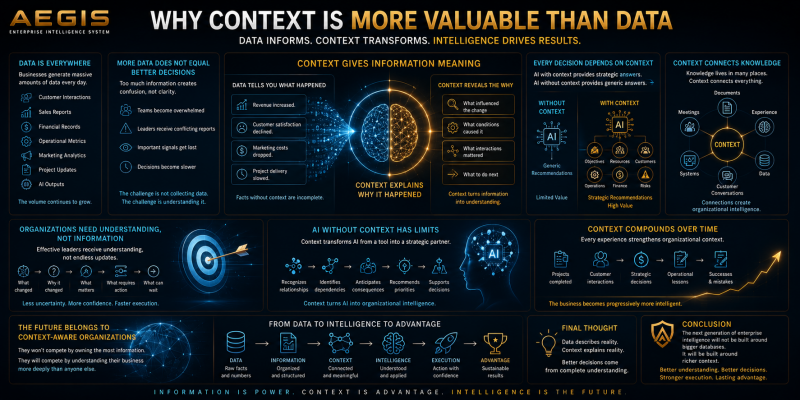
Why Context Is More Valuable Than Data
Data is everywhere.
Modern businesses generate enormous amounts of information every day.
Customer interactions.
Sales reports.
Financial records.
Operational metrics.
Marketing analytics.
Project updates.
AI outputs.
The volume continues to grow.
Yet many organizations still struggle to make better decisions.
More data does not automatically create better decisions.
Companies often believe that collecting more information will solve their problems.
In reality, excessive data frequently creates confusion.
Teams become overwhelmed.
Leaders receive conflicting reports.
Important signals disappear inside endless dashboards and spreadsheets.
The challenge is no longer collecting information.
The challenge is understanding it.
Context gives information meaning.
A single number rarely tells the full story.
Revenue increased.
Customer satisfaction declined.
Marketing costs dropped.
Project delivery slowed.
Each statement describes what happened.
Context explains why it happened.
Without context, information remains incomplete.
Every business decision depends on context.
Imagine asking AI:
"Which project should we prioritize?"
Without organizational context, the answer is generic.
Now imagine AI understands:
- company objectives,
- available resources,
- customer priorities,
- operational capacity,
- financial targets,
- historical performance,
- ongoing risks.
The answer becomes strategic.
The same AI becomes significantly more valuable because it understands the business.
Context connects knowledge.
Knowledge rarely exists inside one system.
Part of it lives inside documents.
Another part exists in meetings.
Some remains inside employee experience.
Some comes from customer conversations.
Context connects these pieces into one coherent picture.
That is how organizational intelligence emerges.
Organizations need understanding, not information.
Many executives spend their days searching for updates.
The most effective leaders receive understanding instead.
They know:
- what changed,
- why it changed,
- what matters,
- what requires action,
- what can wait.
This reduces uncertainty.
Confidence increases.
Execution becomes faster.
AI without context has limits.
Artificial intelligence can process extraordinary amounts of data.
But processing information is different from understanding an organization.
Context transforms AI from an assistant into a strategic partner.
It allows AI to:
- recognize relationships,
- identify dependencies,
- anticipate consequences,
- recommend priorities,
- support executive decisions.
Context compounds over time.
Every completed project.
Every customer interaction.
Every strategic decision.
Every operational lesson.
Every success.
Every mistake.
All of it enriches organizational context.
The business becomes progressively more intelligent.
The future belongs to context-aware organizations.
Tomorrow's companies will not compete by owning the most information.
They will compete by understanding their business more deeply than anyone else.
Context becomes the foundation of intelligence.
Intelligence becomes the foundation of execution.
Execution becomes the foundation of competitive advantage.
Final Thought
Data describes reality.
Context explains reality.
Organizations that understand the difference will consistently make better decisions than those relying on information alone.
Conclusion
The next generation of enterprise intelligence will not be built around bigger databases.
It will be built around richer context.
Because when every decision is supported by complete organizational understanding, businesses move faster, adapt sooner, and create lasting competitive advantage.
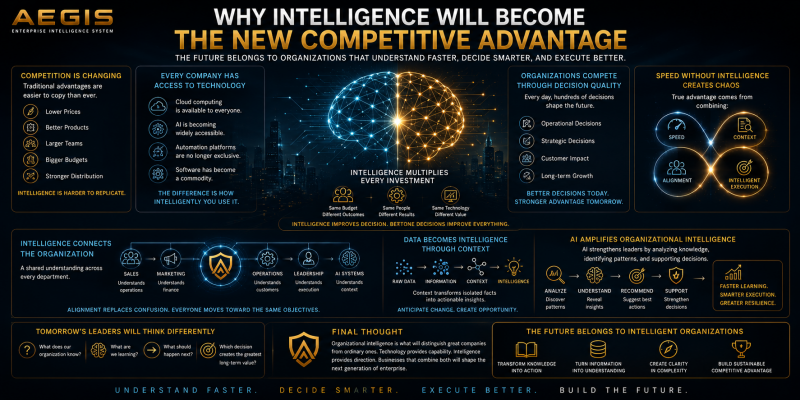
Why Intelligence Will Become the New Competitive Advantage
Competition is changing.
For decades, businesses competed through:
- lower prices,
- better products,
- larger teams,
- bigger budgets,
- stronger distribution.
Those advantages still matter.
But they are becoming easier to copy.
The next competitive advantage will be much harder to replicate.
Intelligence.
Every company has access to technology.
Cloud computing is available to everyone.
Artificial intelligence is becoming widely accessible.
Automation platforms are no longer exclusive.
Software has become a commodity.
What separates organizations is no longer the tools they own.
It is how intelligently they use them.
Intelligence multiplies every investment.
The same budget can produce different outcomes.
The same employees can achieve different results.
The same technology can create different levels of value.
Why?
Because intelligence improves every decision that follows.
Better decisions improve execution.
Better execution improves performance.
Organizations compete through decision quality.
Every business makes hundreds of decisions every day.
Some are operational.
Some are strategic.
Some affect customers.
Others influence long-term growth.
Companies that consistently make better decisions create a compounding advantage over time.
Speed without intelligence creates chaos.
Many organizations pride themselves on moving fast.
Speed alone is not enough.
Fast execution without understanding often increases mistakes.
True competitive advantage comes from combining:
- speed,
- context,
- alignment,
- and intelligent execution.
Intelligence connects the organization.
The strongest companies create a shared understanding across every department.
Sales understands operations.
Marketing understands finance.
Leadership understands execution.
AI understands organizational context.
Everyone moves toward the same objectives.
Alignment replaces confusion.
Data becomes intelligence through context.
Collecting information is only the first step.
Understanding relationships creates value.
Context transforms isolated facts into actionable insights.
Organizations that understand patterns can anticipate change instead of reacting to it.
AI amplifies organizational intelligence.
Artificial intelligence is not replacing leadership.
It is strengthening it.
By analyzing knowledge, identifying patterns, and supporting decision-making, AI enables leaders to focus on strategy rather than searching for information.
The result is faster learning.
Smarter execution.
Greater resilience.
Tomorrow's leaders will think differently.
They will ask:
- What does our organization know?
- What are we learning?
- What should happen next?
- Which decision creates the greatest long-term value?
These questions define intelligent organizations.
Final Thought
Competitive advantage has always evolved.
Factories became infrastructure.
Technology became infrastructure.
Cloud became infrastructure.
Artificial intelligence will become infrastructure too.
Organizational intelligence is what will distinguish great companies from ordinary ones.
Conclusion
The future belongs to organizations that transform knowledge into action and information into understanding.
Technology provides capability.
Intelligence provides direction.
Businesses that combine both will shape the next generation of enterprise.
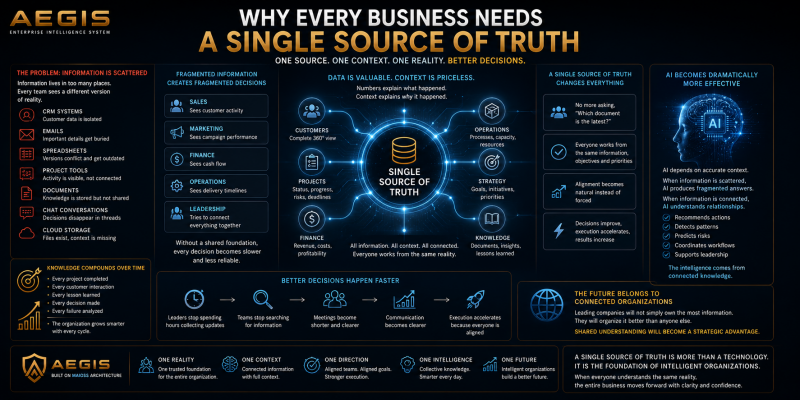
Why Every Business Needs a Single Source of Truth
Every company has information.
Very few have shared understanding.
As organizations grow, information spreads across dozens of platforms.
CRM systems.
Emails.
Project management tools.
Documents.
Spreadsheets.
Chat conversations.
Cloud storage.
Every department creates its own version of reality.
Eventually, nobody sees the complete picture.
Fragmented information creates fragmented decisions.
Sales sees customer activity.
Marketing sees campaign performance.
Finance sees cash flow.
Operations sees delivery timelines.
Leadership tries to connect everything together.
Without a shared foundation, every decision becomes slower and less reliable.
Data is valuable.
Context is priceless.
Numbers explain what happened.
Context explains why it happened.
Understanding relationships between customers, projects, finances, operations, and strategic goals creates a completely different level of intelligence.
This is where true organizational awareness begins.
Knowledge should never depend on memory.
Many businesses unknowingly rely on individuals instead of systems.
A project manager remembers the details.
A salesperson knows the customer history.
A founder understands the strategy.
When knowledge exists only inside people, the organization becomes fragile.
A resilient company stores knowledge where everyone can benefit from it.
A Single Source of Truth changes everything.
Instead of asking:
"Which document is the latest?"
Teams ask:
"What does the organization know?"
Everyone works from the same information.
The same objectives.
The same priorities.
The same operational context.
Alignment becomes natural instead of forced.
AI becomes dramatically more effective.
Artificial intelligence depends on accurate context.
When information is scattered, AI produces fragmented answers.
When information is connected, AI understands relationships.
It can recommend actions.
Detect patterns.
Predict risks.
Coordinate workflows.
Support leadership.
The intelligence doesn't come from AI alone.
It comes from connected knowledge.
Better decisions happen faster.
Leaders no longer spend hours collecting updates.
Teams stop searching for information.
Meetings become shorter.
Communication becomes clearer.
Execution accelerates because everyone starts from the same understanding.
Intelligence compounds over time.
Every completed project.
Every customer interaction.
Every lesson learned.
Every successful decision.
Every failure analyzed.
All of it becomes part of the organization's collective intelligence.
The company grows smarter with every cycle.
The future belongs to connected organizations.
Tomorrow's leading companies will not simply own the most information.
They will organize it better than anyone else.
Shared understanding will become a strategic advantage.
Knowledge will become infrastructure.
Intelligence will become the operating system.
Final Thought
Businesses often search for the next breakthrough technology.
Many already possess their greatest advantage.
It exists inside their own knowledge.
The opportunity lies in connecting it.
Conclusion
A Single Source of Truth is more than a technology concept.
It is the foundation of intelligent organizations.
When every team works from the same knowledge, decisions improve, execution accelerates, and the entire business moves with greater clarity.
Because organizations succeed when everyone understands the same reality.
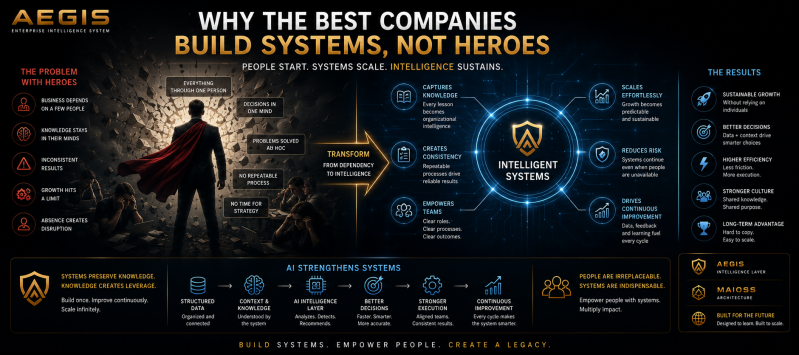
Why The Best Companies Build Systems, Not Heroes
Every successful business starts with people.
Founders make decisions.
Teams solve problems.
Employees create value.
Individual talent matters.
But long-term success depends on something much larger.
Systems.
Heroes cannot scale.
Many companies become dependent on a few key people.
The founder knows everything.
One employee understands the operations.
One manager handles every important decision.
One specialist keeps critical processes running.
The business grows.
The dependence grows with it.
Eventually the organization reaches its limit.
Systems create consistency.
Great systems ensure that success does not depend on luck or memory.
They create:
- repeatable processes,
- shared knowledge,
- clear responsibilities,
- measurable outcomes,
- reliable execution.
Consistency becomes part of the organization itself.
Businesses should grow beyond individuals.
A healthy company continues to perform even when someone is unavailable.
Knowledge remains accessible.
Processes continue.
Customers receive the same experience.
Decisions follow established principles.
That resilience comes from systems, not individuals.
Every system captures experience.
Each challenge solved.
Each customer interaction.
Each successful campaign.
Each operational improvement.
Every lesson becomes organizational knowledge.
Over time, the company becomes smarter because it remembers.
AI strengthens systems not replaces people.
Artificial intelligence performs best inside structured organizations.
When workflows are clear...
AI accelerates them.
When knowledge is organized...
AI understands it.
When objectives are aligned...
AI supports better decisions.
Technology amplifies good systems.
It cannot compensate for missing ones.
Intelligent companies think differently.
Instead of asking:
"Who knows the answer?"
They ask:
"Does the organization know the answer?"
Knowledge becomes collective.
Execution becomes coordinated.
Growth becomes sustainable.
Systems create freedom.
Founders often believe they must stay involved in everything.
The opposite is true.
Strong systems reduce dependency.
Teams become more autonomous.
Leaders gain time to focus on strategy instead of constant problem-solving.
The future belongs to scalable organizations.
Markets will continue changing.
Technology will continue evolving.
Organizations built around individuals will constantly struggle to keep up.
Organizations built around intelligent systems will continuously improve.
Final Thought
People build companies.
Systems build lasting companies.
The organizations that capture knowledge, standardize execution, and continuously improve create an advantage that competitors struggle to replicate.
Conclusion
The goal is never to replace people.
The goal is to empower them through systems that preserve knowledge, improve decisions, and scale execution.
Because businesses built around heroes eventually reach a limit.
Businesses built around intelligent systems continue to grow.
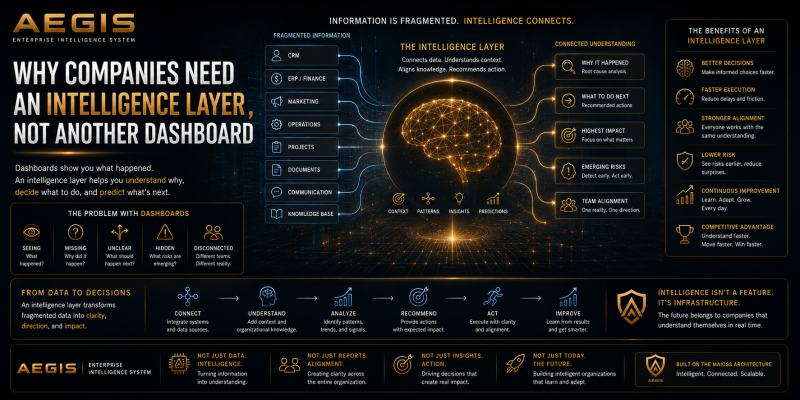
Why Companies Need an Intelligence Layer, Not Another Dashboard
Dashboards are everywhere.
Almost every business has dashboards.
Sales dashboards.
Marketing dashboards.
Financial dashboards.
Operational dashboards.
Performance dashboards.
The problem is not visibility.
The problem is understanding.
Seeing information is different from understanding it.
Dashboards answer one question:
What happened?
Modern organizations need answers to much harder questions:
- Why did it happen?
- What should happen next?
- Which decision creates the greatest impact?
- What risks are emerging?
- Which teams need to act?
Information alone cannot answer these questions.
Context can.
More dashboards create more fragmentation.
Every department builds its own reports.
Marketing sees one version of reality.
Finance sees another.
Operations works from different data.
Leadership spends valuable time connecting the pieces.
The business becomes data-rich but insight-poor.
Context is the missing layer.
An intelligence layer connects information across the organization.
It understands:
- objectives,
- priorities,
- workflows,
- historical decisions,
- organizational knowledge,
- operational performance.
Instead of isolated reports, leaders gain connected understanding.
Decision quality becomes the real advantage.
The companies that outperform competitors rarely make perfect decisions.
They make informed decisions faster.
They understand:
- what matters,
- what changed,
- what requires action,
- and what can wait.
That clarity reduces uncertainty.
AI becomes dramatically more valuable.
Artificial intelligence without organizational context behaves like a general assistant.
Artificial intelligence with organizational context becomes a strategic advisor.
It can:
- recognize patterns,
- identify risks,
- recommend actions,
- coordinate workflows,
- support leadership decisions.
The technology stays the same.
The intelligence becomes significantly stronger.
An intelligence layer connects the entire business.
Instead of creating another platform, it connects existing ones.
CRM.
ERP.
Project management.
Finance.
Documentation.
Communication.
Knowledge systems.
The goal is not replacing software.
The goal is creating understanding across software.
The future belongs to connected organizations.
Businesses have spent decades digitizing operations.
The next decade will focus on connecting intelligence.
Organizations that understand themselves in real time will move faster than those relying on disconnected reports.
Intelligence becomes infrastructure.
Final Thought
Companies do not need more information.
They need better understanding.
The difference between information and intelligence determines the quality of every decision an organization makes.
Conclusion
The next competitive advantage will not come from another dashboard.
It will come from an intelligence layer that transforms fragmented information into shared understanding.
Because businesses that understand faster...
decide faster.
Organizations that decide faster...
execute better.
And organizations that execute better...
build the future.
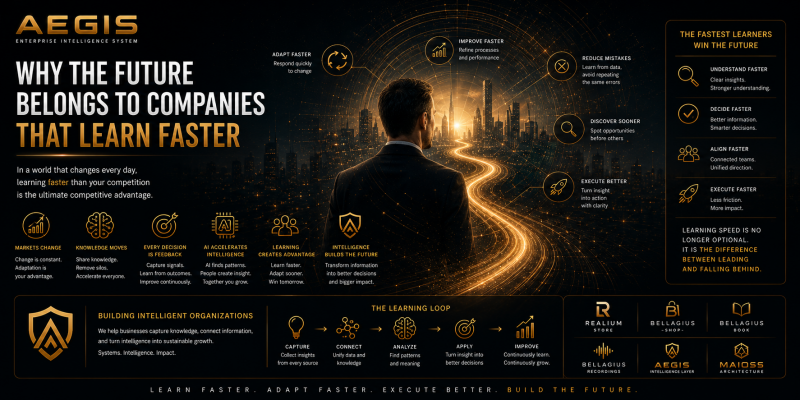
Why The Future Belongs To Companies That Learn Faster
Every company learns.
The question is how fast.
Markets change.
Technology evolves.
Customer expectations shift.
New competitors appear.
The organizations that adapt quickly gain an advantage.
The organizations that learn slowly fall behind.
Size no longer guarantees success.
Large companies once dominated because they possessed:
- more capital,
- more employees,
- more infrastructure,
- more resources.
Today smaller organizations often outperform larger competitors.
Because speed has become more valuable than size.
Learning speed determines adaptation speed.
Experience alone is no longer enough.
Many businesses rely heavily on past success.
Previous strategies.
Established processes.
Historical assumptions.
But markets continuously change.
What worked five years ago may already be obsolete.
Organizations must continuously update their understanding.
Knowledge must move quickly.
Information trapped inside departments slows the entire company.
Teams repeat mistakes.
Decisions become inconsistent.
Lessons remain isolated.
Organizational learning requires:
- shared knowledge,
- connected systems,
- transparent information,
- accessible insights.
The faster knowledge moves, the faster organizations improve.
Every decision becomes feedback.
Modern businesses generate enormous amounts of learning opportunities.
Customer behavior.
Sales conversations.
Operational results.
Marketing performance.
Execution outcomes.
The companies that capture these signals improve continuously.
The companies that ignore them repeat the same mistakes.
AI changes the speed of learning.
Artificial intelligence does not replace organizational intelligence.
It accelerates it.
AI can identify patterns.
Detect problems.
Surface opportunities.
Connect information.
But these capabilities only create value when organizations learn from them.
Learning creates competitive advantage.
The fastest learners:
- adapt sooner,
- improve faster,
- reduce mistakes,
- discover opportunities earlier.
Their advantage compounds.
Over time the gap becomes enormous.
Intelligent organizations evolve continuously.
Future businesses will not operate through annual adjustments.
They will learn daily.
Knowledge systems.
Enterprise intelligence.
AI-driven insights.
Operational feedback.
Continuous adaptation becomes part of the organization itself.
The next generation of companies behaves differently.
They ask:
- What did we learn?
- What changed?
- What patterns emerged?
- What should improve?
- What should stop?
Learning becomes operational.
Not occasional.
Final Thought
Companies do not fail because markets change.
They fail because they stop learning.
The future belongs to organizations that transform information into knowledge, knowledge into intelligence, and intelligence into better decisions.
Conclusion
Learning speed is becoming one of the most important business advantages.
The organizations that understand faster will adapt faster.
The organizations that adapt faster will execute better.
And the organizations that execute better will build the future.
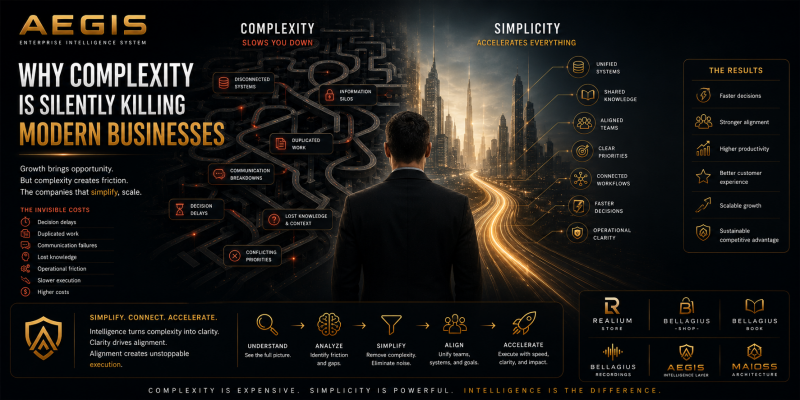
Why Complexity Is Silently Killing Modern Businesses
Growth often creates a hidden problem.
Most companies want:
- more customers,
- more products,
- more systems,
- more employees,
- more opportunities.
Growth feels like progress.
But growth also creates complexity.
And complexity quietly destroys performance.
Complexity hides inside successful companies.
It rarely appears during the early stages.
Small teams move quickly.
Decisions happen naturally.
Information flows easily.
Everyone understands the mission.
As companies grow, something changes.
New tools appear.
Departments separate.
Processes multiply.
Meetings increase.
Information becomes fragmented.
More systems do not always create better businesses.
Organizations often add:
- additional software,
- new platforms,
- new communication tools,
- new reporting systems,
- new workflows.
Each solution solves one problem.
Over time these solutions create dozens of new problems.
Disconnected systems create disconnected organizations.
Complexity creates invisible costs.
Many leaders measure financial costs.
Very few measure:
- decision delays,
- duplicated work,
- communication failures,
- conflicting priorities,
- lost knowledge,
- operational friction.
These costs compound every day.
Eventually the organization becomes slower than its competitors.
Speed becomes difficult.
Employees spend time searching for information.
Managers spend time aligning teams.
Executives spend time resolving misunderstandings.
Decisions require multiple meetings.
Execution slows.
The company becomes busy.
Productivity decreases.
Customers eventually feel the complexity.
Internal complexity always becomes external.
Customers experience:
- slower responses,
- inconsistent service,
- confusing communication,
- delayed execution.
Trust begins to weaken.
Growth becomes more expensive.
Simplicity creates leverage.
The strongest organizations intentionally reduce complexity.
They create:
- clear priorities,
- unified systems,
- shared knowledge,
- aligned teams,
- connected workflows.
This creates operational clarity.
Clarity accelerates execution.
Intelligence reduces complexity.
Modern organizations do not necessarily need more software.
They need better coordination.
Information must connect.
Knowledge must become accessible.
Decisions must operate within context.
Execution must align with objectives.
This is where organizational intelligence becomes valuable.
The future belongs to simpler organizations.
Not smaller.
Simpler.
Organizations that can:
- understand faster,
- decide faster,
- align faster,
- execute faster.
Complexity slows companies.
Intelligence simplifies them.
Final Thought
Many businesses believe they suffer from insufficient resources.
The real challenge is often excessive complexity.
The organizations that remove friction gain speed.
The organizations that gain speed create advantage.
Conclusion
Complexity is one of the most expensive problems in modern business.
It reduces clarity.
It slows execution.
It weakens alignment.
Companies that learn to simplify systems, decisions, and knowledge create something extremely valuable:
organizational speed.
And in the next decade, speed will become one of the most important competitive advantages.
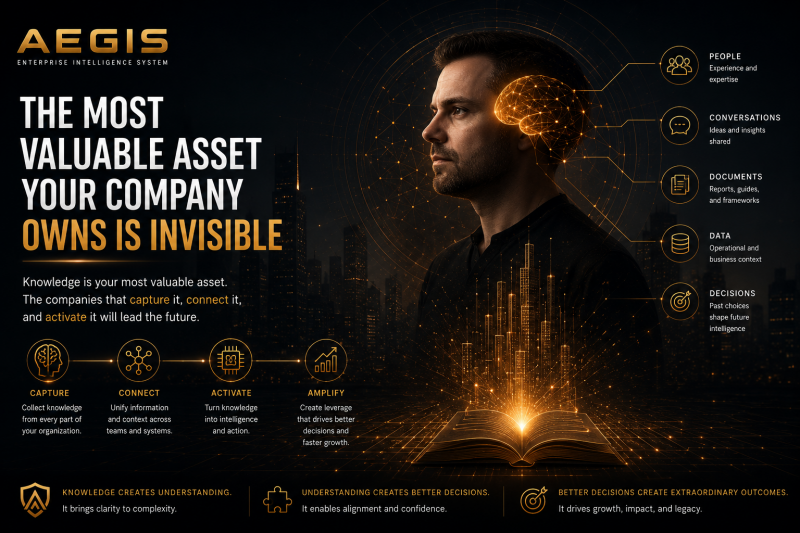
The Most Valuable Asset Your Company Owns Is Invisible
Most businesses measure the wrong assets.
Companies track:
- revenue,
- inventory,
- equipment,
- software,
- marketing spend,
- and financial performance.
These assets matter.
But the most valuable asset inside almost every organization rarely appears on a balance sheet.
Knowledge.
Knowledge exists everywhere.
Inside every business there are years of accumulated experience.
Lessons learned.
Customer insights.
Operational expertise.
Decision frameworks.
Problem-solving methods.
Strategic thinking.
The challenge is that this knowledge rarely exists in one place.
It is scattered across:
- emails,
- documents,
- meetings,
- conversations,
- spreadsheets,
- and individual employees.
Most organizational knowledge is trapped.
A surprising amount of business intelligence exists only inside people's minds.
When key employees leave, knowledge leaves with them.
When teams grow, information becomes fragmented.
When organizations scale, communication becomes increasingly difficult.
The result is operational friction.
Not because people lack knowledge.
Because knowledge lacks structure.
Information and knowledge are not the same thing.
Many businesses collect enormous amounts of data.
Few successfully transform it into organizational knowledge.
Information answers questions.
Knowledge improves decisions.
That difference creates competitive advantage.
Every growing company faces the same challenge.
Growth increases complexity.
More customers.
More products.
More systems.
More employees.
More decisions.
Without a framework for capturing and distributing knowledge, complexity grows faster than intelligence.
And complexity eventually slows execution.
The next generation of companies will operate differently.
Future-ready organizations will treat knowledge as infrastructure.
Just as businesses invest in:
- technology,
- operations,
- finance,
- and logistics,
they will invest in systems that capture, organize, and activate intelligence.
Knowledge will become operational.
Not archival.
Organizational intelligence creates leverage.
A company becomes significantly more effective when every team can access:
- historical decisions,
- operational context,
- strategic priorities,
- customer understanding,
- and institutional knowledge.
The organization stops repeating mistakes.
Execution becomes faster.
Alignment becomes stronger.
AI increases the importance of knowledge.
Many leaders believe AI is primarily about automation.
The larger opportunity is intelligence amplification.
AI performs best when it understands context.
Context comes from organizational knowledge.
Without knowledge, AI becomes another tool.
With knowledge, AI becomes a force multiplier.
The companies that win will learn faster.
Markets change.
Technology evolves.
Customer expectations shift.
The organizations that adapt fastest gain an enormous advantage.
Learning speed becomes competitive advantage.
Knowledge systems accelerate learning.
Final Thought
Buildings can be replaced.
Software can be replaced.
Processes can be replaced.
The accumulated intelligence of an organization is far harder to recreate.
Because every lesson, every decision, and every experience contributes to something larger:
organizational knowledge.
Conclusion
The most valuable asset your company owns is invisible.
It lives inside people, systems, decisions, and experience.
The future belongs to organizations that learn how to capture that knowledge, connect it, and transform it into intelligence.
Because knowledge creates understanding.
Understanding creates better decisions.
And better decisions create extraordinary outcomes.
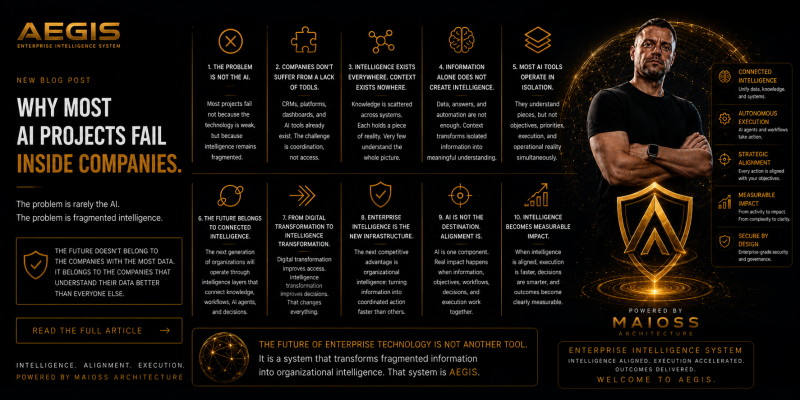
Why Most AI Projects Fail Inside Companies
The problem is rarely the AI.
Every year companies invest millions into:
- AI tools,
- automation platforms,
- dashboards,
- software integrations,
- and digital transformation initiatives.
Yet many projects fail to create meaningful business impact.
Not because the technology is weak.
Because the intelligence remains fragmented.
Companies don't suffer from a lack of tools.
Most organizations already have:
- CRMs,
- project management systems,
- communication platforms,
- analytics dashboards,
- documentation systems,
- and growing collections of AI tools.
The challenge is not access to information.
The challenge is coordination.
Intelligence exists everywhere.
But context exists nowhere.
Knowledge is scattered across:
- meetings,
- emails,
- reports,
- documents,
- conversations,
- workflows,
- and operational systems.
Each system contains a piece of reality.
Very few systems understand the whole picture.
Information alone does not create intelligence.
A dashboard can display data.
A chatbot can answer questions.
An automation can execute tasks.
But business intelligence requires something more:
context.
Context transforms isolated information into meaningful understanding.
Without context, organizations become reactive.
Most AI tools operate in isolation.
This is one of the biggest limitations of current enterprise technology.
An AI assistant may understand a document.
A CRM may understand customers.
A project management platform may understand tasks.
But very few systems understand:
- objectives,
- priorities,
- execution,
- operational reality,
- and organizational knowledge simultaneously.
That gap creates friction.
The future belongs to connected intelligence.
The next generation of organizations will not operate through isolated software.
They will operate through intelligence layers.
Systems capable of connecting:
- knowledge,
- workflows,
- AI agents,
- decision systems,
- and execution frameworks.
Into a single operational environment.
This is the shift from digital transformation to intelligence transformation.
Digital transformation focused on digitizing processes.
Intelligence transformation focuses on understanding them.
One improves access.
The other improves decisions.
That difference changes everything.
Enterprise intelligence becomes the new infrastructure.
Companies once competed through:
- capital,
- talent,
- and technology.
The next competitive advantage will be organizational intelligence.
The ability to transform information into coordinated action faster than competitors.
AI alone is not the destination.
AI is one component.
The real objective is alignment.
When information, objectives, workflows, decisions, and execution operate together, organizations become significantly more effective.
That is where measurable impact emerges.
Final Thought
The companies that dominate the next decade will not necessarily own the most data.
They will understand their data better than everyone else.
Because intelligence is not created through accumulation.
It is created through connection.
Conclusion
The future of enterprise technology is not another dashboard.
Not another automation.
Not another isolated AI tool.
The future belongs to systems that transform fragmented information into organizational intelligence.
And organizational intelligence will become the operating system of modern business.
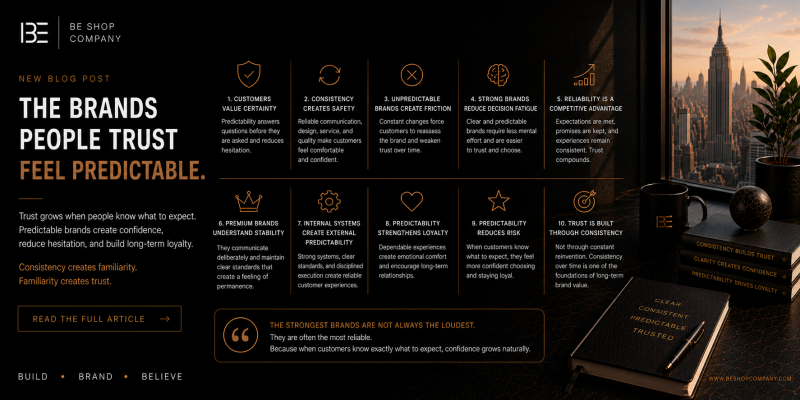
The Brands People Trust Feel Predictable
Predictability is underrated.
Many founders believe customers want constant excitement.
New ideas.
New campaigns.
New offers.
New directions.
But trust is usually built differently.
Trust grows when people know what to expect.
And predictable brands create confidence.
Customers value certainty.
Every purchase contains uncertainty.
People naturally ask:
- Will this brand deliver?
- Will the experience match expectations?
- Will quality remain consistent?
- Can I trust this company long term?
Predictability answers these questions before they are asked.
That reduces hesitation.
Consistency creates emotional safety.
Human psychology favors reliability.
Customers feel more comfortable engaging with brands that behave consistently.
This applies to:
- communication,
- design,
- customer service,
- product quality,
- and overall experience.
Consistency creates familiarity.
Familiarity creates trust.
Unpredictable brands create friction.
Many businesses unintentionally damage trust by constantly changing:
- messaging,
- positioning,
- priorities,
- aesthetics,
- or customer experience.
Each change forces customers to reassess what the brand actually represents.
That creates uncertainty.
And uncertainty weakens confidence.
Strong brands reduce decision fatigue.
Customers interact with thousands of messages every day.
Brands that feel clear and predictable require less mental effort to understand.
That simplicity becomes valuable.
People trust what feels easy to understand.
Reliability is a competitive advantage.
Many companies focus heavily on innovation.
Few focus enough on reliability.
Yet reliability often wins long term.
Customers return because:
- expectations are met,
- promises are kept,
- and experiences remain consistent.
Trust compounds through repetition.
Premium brands understand stability.
Luxury brands rarely appear chaotic.
They communicate deliberately.
Their identity remains recognizable year after year.
Their standards remain clear.
This creates a feeling of permanence.
And permanence increases perceived value.
Internal systems create external predictability.
Reliable customer experiences rarely happen by accident.
They are usually the result of:
- strong systems,
- clear standards,
- disciplined execution,
- and operational consistency.
The customer only sees the outcome.
But the outcome reflects internal structure.
Predictability strengthens loyalty.
People stay loyal to brands that consistently deliver positive experiences.
Not because every interaction is exciting.
Because every interaction feels dependable.
Dependability creates emotional comfort.
And emotional comfort encourages long-term relationships.
Final Thought
The strongest brands are not always the loudest.
They are often the most reliable.
Customers trust brands that feel stable, consistent, and predictable.
Because predictability reduces risk.
And reduced risk increases confidence.
Conclusion
Strong brands understand that trust is built through consistency repeated over time.
Not through constant reinvention.
Because when customers know exactly what to expect, confidence grows naturally.
And confidence is one of the foundations of long-term brand value.
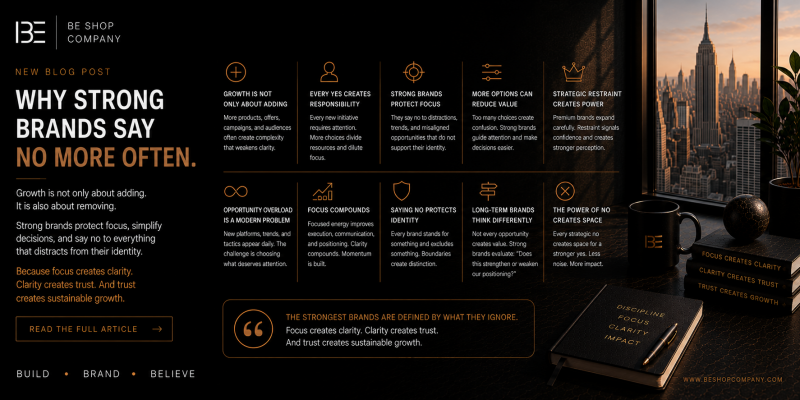
Why Strong Brands Say No More Often
Growth is not only about adding.
It is also about removing.
Many businesses believe success comes from:
- more products,
- more offers,
- more campaigns,
- more audiences,
- and more opportunities.
But over time, constant addition often creates complexity.
And complexity weakens clarity.
Every yes creates responsibility.
This is something many founders underestimate.
Every new:
- product,
- feature,
- partnership,
- audience,
- or initiative
requires attention.
Resources become divided.
Focus becomes diluted.
Execution becomes slower.
The business becomes harder to manage.
Strong brands protect focus.
The strongest brands are often defined by what they refuse to do.
They say no to:
- unnecessary opportunities,
- distracting trends,
- conflicting partnerships,
- and ideas that do not align with their identity.
This discipline protects positioning.
Because focus creates strength.
More options can reduce value.
Psychologically, excessive choice often creates confusion.
Customers trust brands that feel:
- clear,
- confident,
- and intentional.
When everything is offered, nothing feels important.
Strong brands simplify decision making.
They guide attention rather than overwhelm it.
Strategic restraint creates power.
Many premium brands understand this principle deeply.
They do not try to dominate every category.
They do not launch endlessly.
They expand carefully.
Every decision supports the overall identity.
This creates stronger perception.
Because restraint signals confidence.
Most businesses suffer from opportunity overload.
Modern entrepreneurship creates endless possibilities.
Every day there are:
- new platforms,
- new trends,
- new markets,
- new tactics,
- and new opportunities.
The challenge is not finding opportunities.
The challenge is choosing which opportunities deserve attention.
Focus compounds.
When energy is concentrated:
- execution improves,
- communication improves,
- positioning strengthens,
- and trust increases.
Focused businesses often outperform larger competitors simply because they execute with greater clarity.
Scattered businesses lose momentum.
Focused businesses build it.
Saying no protects identity.
Every brand stands for something.
But every brand also excludes something.
That exclusion creates distinction.
Without boundaries, positioning becomes weak.
Without positioning, recognition becomes difficult.
And without recognition, growth becomes expensive.
Long-term brands think differently.
They understand that not every opportunity creates value.
Some opportunities create distraction.
Some create complexity.
Some create identity drift.
Strong brands evaluate opportunities through one question:
"Does this strengthen or weaken our long-term positioning?"
Final Thought
Many businesses believe growth comes from doing more.
Often it comes from doing less better.
Because every strategic no creates space for a stronger yes.
And brands that protect focus usually build stronger trust, stronger recognition, and stronger long-term value.
Conclusion
The strongest brands are not defined by everything they pursue.
They are defined by what they intentionally ignore.
Because focus creates clarity.
Clarity creates trust.
And trust creates sustainable growth.
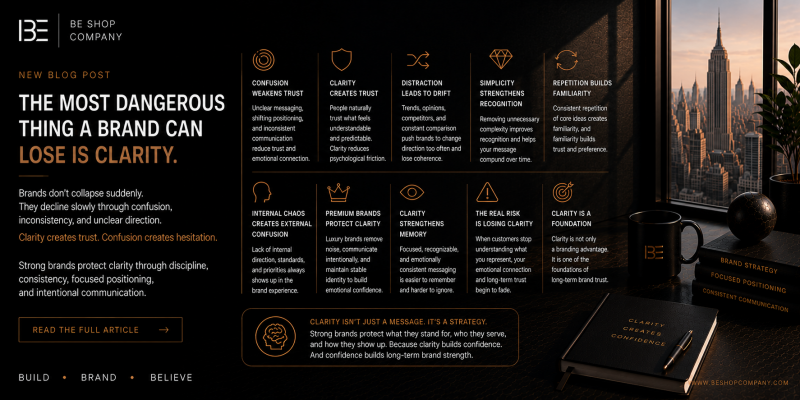
The Most Dangerous Thing A Brand Can Lose Is Clarity
Brands rarely collapse instantly.
Most decline happens slowly.
Not through one catastrophic mistake.
But through gradual confusion.
The messaging becomes inconsistent.
The positioning becomes unclear.
The identity starts shifting constantly.
The communication loses focus.
And over time, customers stop understanding what the brand actually represents.
Clarity creates trust.
People naturally trust what feels understandable and predictable.
Strong brands communicate clearly:
- who they are,
- what they stand for,
- who they serve,
- and how they operate.
This reduces psychological friction.
Customers feel more confident engaging with brands that feel easy to understand emotionally.
Confused brands create hesitation.
When positioning becomes unclear:
- trust weakens,
- recognition decreases,
- and emotional connection fades.
Customers hesitate when a brand feels inconsistent.
Even if the product itself remains good.
Because confusion increases perceived risk.
And perceived risk reduces action.
Modern businesses are constantly distracted.
The internet creates endless pressure:
- trends,
- opinions,
- algorithms,
- competitors,
- and constant comparison.
Because of this, many businesses begin changing direction too frequently.
They:
- alter their tone,
- redesign constantly,
- chase every trend,
- and reposition repeatedly.
Eventually the brand loses coherence.
Clarity requires discipline.
Strong brands intentionally remove unnecessary complexity.
They simplify:
- communication,
- visuals,
- offers,
- positioning,
- and strategic direction.
Because simplicity improves recognition.
And recognition compounds over time.
Strong positioning is repetitive by nature.
Many founders become bored with their own messaging too quickly.
But customers usually need repetition before recognition fully develops.
The strongest brands repeat core ideas consistently:
- visually,
- emotionally,
- and strategically.
This creates familiarity.
And familiarity builds trust.
Internal confusion becomes external confusion.
Brands cannot communicate clarity externally without internal alignment first.
If leadership lacks:
- direction,
- standards,
- priorities,
- or consistency,
the brand eventually reflects that instability publicly.
Customers notice emotional disorder faster than many businesses realize.
Premium brands protect clarity carefully.
Luxury positioning often feels simple.
Not because little thought exists behind it.
But because unnecessary noise was removed.
Strong premium brands:
- communicate intentionally,
- maintain stable identity,
- and avoid unnecessary complexity.
This creates stronger emotional confidence.
Clarity strengthens memory.
People remember brands more easily when the message feels:
- focused,
- recognizable,
- and emotionally consistent.
Complexity weakens memorability.
Clarity strengthens positioning.
That is why the strongest brands often feel simple externally while operating with enormous discipline internally.
Final Thought
The most dangerous thing a brand can lose is not visibility.
It is clarity.
Because once customers stop understanding what the brand represents, emotional connection weakens quickly.
And without emotional clarity, long-term trust becomes difficult to maintain.
Conclusion
Strong brands protect clarity relentlessly.
Through:
- consistency,
- discipline,
- focused positioning,
- and intentional communication.
Because clarity is not only a branding advantage.
It is one of the foundations of long-term brand trust.
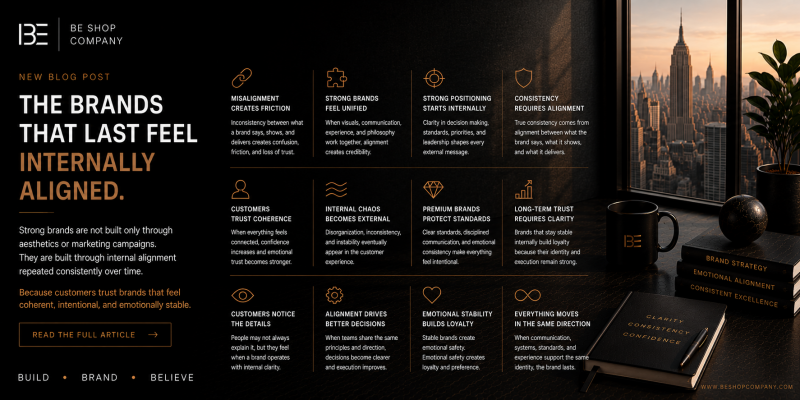
The Brands That Last Feel Internally Aligned
Many brands look polished externally.
But internally, everything feels disconnected.
The marketing says one thing.
The customer experience says another.
The product quality feels inconsistent.
The communication lacks clarity.
Over time, customers notice this disconnect.
And disconnect weakens trust.
Strong brands feel unified.
Everything works together:
- visuals,
- communication,
- customer experience,
- positioning,
- and overall philosophy.
This creates alignment.
And alignment creates credibility.
Customers feel when a brand operates with internal clarity.
Even if they cannot explain it directly.
Misalignment creates friction.
This is one of the biggest hidden problems in branding.
A company may:
- look premium,
- sound ambitious,
- and market aggressively,
while internally operating chaotically.
Customers eventually feel this inconsistency through:
- poor experiences,
- confusing communication,
- weak execution,
- or emotional instability.
Brand perception always reflects operational reality eventually.
Strong positioning starts internally.
A brand cannot communicate clarity externally if clarity does not exist internally first.
This applies to:
- decision making,
- standards,
- priorities,
- systems,
- and leadership philosophy.
The strongest brands usually have very clear internal principles.
That clarity shapes everything else naturally.
Consistency requires alignment.
Many businesses try to appear consistent visually while changing direction constantly operationally.
This creates emotional confusion.
Strong brands align:
- what they say,
- what they show,
- and what customers actually experience.
That alignment builds trust faster than marketing alone.
Customers trust coherence.
Human psychology naturally trusts things that feel organized and predictable.
When every part of a brand feels connected:
- confidence increases,
- perceived professionalism increases,
- and emotional trust becomes stronger.
Coherence creates comfort.
And comfort reduces hesitation.
Internal chaos eventually becomes external.
This is unavoidable.
Disorganized businesses often reveal themselves through:
- inconsistent quality,
- unstable communication,
- reactive decision making,
- and emotional volatility.
Even strong marketing cannot permanently hide weak internal structure.
Eventually the customer experience exposes reality.
Premium brands protect standards carefully.
Luxury positioning is rarely accidental.
Strong premium brands usually maintain:
- clear operational standards,
- disciplined communication,
- emotional consistency,
- and strategic restraint.
Everything feels intentional because internal alignment exists behind the scenes.
Long-term trust requires internal clarity.
Customers stay loyal to brands that feel stable.
And stability is difficult to fake long term.
The strongest businesses create trust because:
- their identity is clear,
- their execution is consistent,
- and their internal philosophy supports their external positioning.
That creates durability.
Final Thought
Strong brands are not built only through aesthetics or marketing campaigns.
They are built through internal alignment repeated consistently over time.
Because customers trust brands that feel coherent, intentional, and emotionally stable.
And coherence is difficult to replicate without real internal clarity.
Conclusion
The brands that last usually feel unified internally and externally.
Their:
- communication,
- systems,
- standards,
- and customer experience
all support the same identity.
Because long-term brand strength is built when everything moves in the same direction.
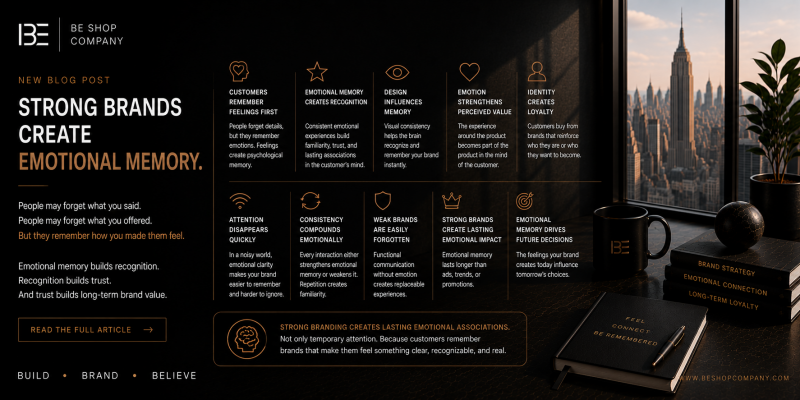
Strong Brands Create Emotional Memory
Most businesses focus only on visibility.
They want:
- more reach,
- more clicks,
- more impressions,
- and more engagement.
But visibility alone is not enough.
People forget most brands almost immediately.
Because attention without emotional memory disappears quickly.
Customers remember feelings first.
This is one of the most important principles in branding.
People may forget:
- exact product details,
- specifications,
- or advertisements.
But they remember how a brand made them feel.
That emotional impression becomes psychological memory.
And psychological memory influences future decisions.
Emotional memory creates recognition.
The strongest brands feel familiar even after long periods of time.
Why?
Because consistent emotional experiences create lasting associations.
Customers begin connecting the brand with:
- trust,
- confidence,
- clarity,
- aspiration,
- or identity.
This is far more powerful than temporary attention.
Weak branding creates forgettable experiences.
Many businesses communicate functionally but not emotionally.
They explain:
- features,
- prices,
- specifications,
- and offers.
But they fail to create emotional resonance.
Without emotional impact, the interaction becomes replaceable.
And replaceable brands usually compete on price.
Design influences memory.
Visual consistency matters because the brain remembers patterns.
Typography.
Color balance.
Spacing.
Photography style.
Communication tone.
All of these shape emotional recognition.
Strong branding creates visual familiarity that customers recognize instantly.
Emotion strengthens perceived value.
This is why premium brands invest heavily into:
- atmosphere,
- presentation,
- storytelling,
- and controlled communication.
Because emotional perception changes how people evaluate value.
The experience around the product often becomes part of the product itself.
Strong brands create identity reinforcement.
Customers often buy from brands that reinforce:
- who they are,
- how they want to feel,
- or how they want to be perceived.
This creates deeper emotional attachment.
And emotional attachment creates stronger loyalty.
The internet weakens attention spans.
Modern consumers process enormous amounts of information daily.
Most content disappears instantly.
That is why emotional clarity matters more than ever.
Brands that create recognizable emotional patterns become easier to remember in crowded environments.
Consistency compounds emotionally.
Emotional memory is not built through one perfect campaign.
It is built through repeated consistency.
Every interaction either:
- strengthens recognition,
- or weakens it.
Strong brands protect emotional consistency carefully because repetition creates familiarity.
And familiarity creates trust.
Final Thought
People rarely remember every detail about a brand.
But they remember emotional impressions surprisingly well.
The strongest brands understand that long-term positioning is not built only through visibility.
It is built through emotional memory repeated consistently over time.
Conclusion
Strong branding creates lasting emotional associations.
Not only temporary attention.
Because customers remember brands that make them feel something clear, recognizable, and emotionally consistent.
And emotional memory is one of the strongest long-term advantages a brand can build.
Discipline Is More Valuable Than Motivation
Most people are waiting to feel ready.
That is the first mistake.
Motivation is emotional. Discipline is structural.
One disappears when pressure appears. The other continues operating even when energy is low.
Modern business culture often glorifies motivation. Videos. Quotes. Temporary excitement.
But real businesses are rarely built through emotional intensity.
They are built through repetition.
The founder who wins long term is usually not the loudest. Not the most emotional. Not the most publicly “motivated.”
It is often the person who continues executing after the excitement disappears.
Motivation creates starts.
Discipline creates results.
Many entrepreneurs love beginnings.
New ideas. New brands. New plans. New goals.
But very few people truly enjoy maintenance.
The repetitive part. The invisible work. The systems. The consistency.
That is where most businesses quietly fail.
Not because the idea was terrible. But because execution became emotionally dependent.
If productivity only exists when motivation is high, growth becomes unstable.
And unstable systems cannot scale.
Discipline removes emotional decision making.
This is one of the most underrated advantages in business.
Discipline reduces negotiation.
You stop asking:
- “Do I feel like doing this today?”
- “Am I inspired enough?”
- “Should I wait for better timing?”
The decision already exists.
Execution becomes automatic.
This creates momentum. And momentum compounds.
Over time, disciplined execution creates something motivation never can:
predictability.
Strong brands are built through consistency.
Customers trust patterns.
Not random bursts of activity.
A brand that appears consistently:
- feels more established,
- feels more stable,
- and feels more trustworthy.
This applies to:
- design,
- communication,
- customer experience,
- content,
- and overall brand identity.
Consistency creates recognition. Recognition creates trust. Trust creates conversion.
Most people underestimate how psychological repetition really is.
The internet rewards disciplined builders.
Today, attention moves fast.
Trends appear and disappear constantly.
Because of this, many founders become reactive.
They chase:
- algorithms,
- trends,
- shortcuts,
- and temporary visibility.
But the strongest digital brands usually operate differently.
They focus on:
- systems,
- identity,
- quality,
- positioning,
- and long-term perception.
This approach looks slower.
But over time, it becomes far more durable.
Calm execution is a competitive advantage.
Modern business culture is extremely noisy.
Everyone is trying to appear successful. Everyone is performing productivity. Everyone is announcing every move.
But calm execution often produces stronger outcomes.
Less noise. More focus. More strategic thinking. More consistency.
The founders who survive long term usually understand something important:
Business is not built in one intense week. It is built through years of controlled repetition.
Final Thought
Motivation is useful.
But it is unreliable.
Discipline is what continues operating after emotion disappears.
And in modern business, consistency is often more powerful than intensity.
The people who quietly keep building usually outperform the people constantly waiting to feel inspired.
Conclusion
Strong businesses are rarely accidental.
Behind almost every respected brand is:
- repetition,
- structure,
- consistency,
- and disciplined execution.
Because in the long term, discipline scales better than emotion.
Why Most Brands Try Too Hard
Modern branding has a noise problem.
Too many brands are trying to force attention.
Louder colors.
More content.
More trends.
More emotional marketing.
More exaggerated messaging.
But attention is not the same as respect.
And visibility is not the same as positioning.
The strongest brands rarely feel desperate for attention.
They feel controlled.
Strong branding feels effortless.
Not because it is simple to build.
But because unnecessary elements were removed.
Good branding is often subtraction:
- less noise,
- less confusion,
- less visual chaos,
- less forced communication.
Weak brands constantly add.
Strong brands refine.
This difference completely changes perception.
Customers notice emotional instability.
Most founders never think about this.
But brands also communicate emotional energy.
A brand that constantly changes:
- style,
- messaging,
- tone,
- identity,
- or positioning
starts feeling unstable.
And unstable brands are difficult to trust.
Consistency creates psychological safety.
People naturally move toward brands that feel clear and intentional.
Premium brands understand restraint.
Luxury branding is rarely loud.
It does not need to scream quality.
Because confidence changes communication.
Strong brands:
- do not overexplain,
- do not chase every trend,
- do not post endlessly without purpose,
- and do not try to appeal to everyone.
They understand an important principle:
clarity attracts more than noise.
The internet rewards short-term attention.
But brand value is built differently.
This is where many modern businesses fail.
They optimize everything for:
- clicks,
- instant engagement,
- virality,
- and temporary traffic.
But short-term visibility can slowly damage long-term perception.
Especially when the brand identity becomes inconsistent.
A brand should not feel algorithmic.
It should feel recognizable.
Aesthetic alone is not branding.
Minimal design is not enough.
Beautiful visuals are not enough.
Fonts, colors, logos, and layouts matter.
But branding goes deeper than appearance.
Real branding is:
- perception,
- emotional association,
- consistency,
- positioning,
- and psychological memory.
The goal is not only to look good.
The goal is to become recognizable immediately.
Most brands communicate too much.
Customers do not want constant pressure.
Modern consumers are exhausted by:
- endless ads,
- forced urgency,
- exaggerated claims,
- and artificial excitement.
Calm brands stand out because they feel different.
More intentional.
More mature.
More trustworthy.
Sometimes silence communicates more confidence than constant promotion.
Strong brands create identity.
People rarely buy products only for functionality.
They buy:
- emotion,
- self-image,
- belonging,
- aspiration,
- and identity reinforcement.
The product matters.
But the meaning around the product matters too.
That is why branding is psychological before it is visual.
Final Thought
Most brands are trying too hard to be noticed.
And in the process, they lose clarity.
Strong branding is usually quieter.
More focused.
More disciplined.
More intentional.
Because real brand strength is not built through constant noise.
It is built through recognizable identity, controlled execution, and long-term consistency.
Conclusion
The brands people remember rarely feel chaotic.
They feel clear.
And clarity has become one of the most valuable advantages in modern business.
Customers Don’t Buy Products. They Buy Identity.
Most purchases are emotional first.
Logic usually comes later.
People often believe they buy based on:
- specifications,
- features,
- pricing,
- or functionality.
But human decision making is rarely that rational.
Most buying behavior is connected to identity.
People buy things that reinforce how they see themselves — or how they want to be seen.
That changes everything about branding.
Products become symbols.
A product is rarely just a product anymore.
A watch can represent:
- discipline,
- success,
- status,
- taste,
- or ambition.
A minimalist workspace setup can communicate:
- focus,
- clarity,
- professionalism,
- and control.
Even simple purchasing decisions often contain psychological meaning.
This is why branding matters far beyond visuals.
Strong brands attach emotion and identity to ordinary products.
Customers buy alignment.
People naturally move toward brands that feel emotionally familiar.
Not necessarily because the product is objectively better.
But because the brand reflects:
- their lifestyle,
- their values,
- their aspirations,
- or their self-image.
This is why positioning matters so much.
A brand should not try to attract everyone.
The strongest brands attract specific people deeply.
Identity creates loyalty.
Price alone rarely creates long-term customers.
Identity does.
When people emotionally connect to a brand, they stop behaving like pure logical buyers.
The relationship becomes psychological.
Customers begin defending the brand.
Promoting the brand.
Associating themselves with the brand publicly.
This is where real loyalty begins.
Not in discounts.
Not in temporary promotions.
But in emotional alignment.
Strong brands understand perception.
Perception influences value.
Two products can have:
- similar quality,
- similar functionality,
- and similar manufacturing costs
while being perceived completely differently.
Why?
Because branding changes interpretation.
Presentation changes expectation.
Aesthetic changes perceived quality.
Positioning changes perceived value.
This is why premium brands invest heavily into:
- design,
- storytelling,
- consistency,
- packaging,
- and emotional experience.
The internet made identity-based buying stronger.
Social media amplified psychological branding.
Today, purchases are often connected to:
- image,
- personal narrative,
- online identity,
- and social signaling.
People no longer buy only for utility.
They buy for association.
This applies to:
- fashion,
- technology,
- lifestyle products,
- digital products,
- and even business brands.
Modern consumers want products that feel connected to who they are.
Or who they want to become.
Branding is emotional architecture.
Most businesses focus too heavily on transactions.
But strong branding focuses on emotional memory.
How does the brand feel?
What does it represent?
What identity does it reinforce?
These questions matter more than many founders realize.
Because customers remember emotion longer than specifications.
Weak brands sell products.
Strong brands sell meaning.
This is one of the biggest differences in modern business.
Weak brands compete mostly through:
- pricing,
- urgency,
- and short-term tactics.
Strong brands compete through:
- perception,
- emotional positioning,
- identity,
- and trust.
That creates stronger long-term value.
Final Thought
Customers rarely buy only for functionality.
They buy because something feels aligned with their identity.
The strongest brands understand this deeply.
They do not only create products.
They create emotional association.
And emotional association is what transforms ordinary businesses into recognizable brands.
Conclusion
In modern commerce, branding is no longer optional.
Because products can be copied.
But identity is far more difficult to replicate.
The brands that understand human psychology will always build stronger long-term positioning than the brands focused only on selling products.
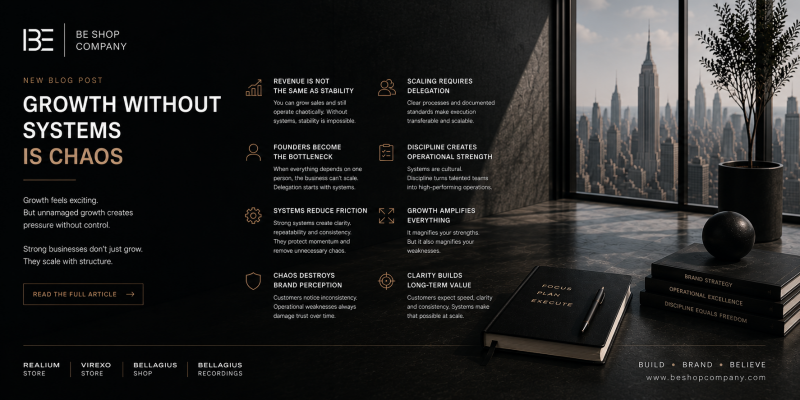
Growth Without Systems Is Chaos
Many businesses fail while growing.
Not while starting.
Growth creates pressure.
More customers.
More decisions.
More communication.
More moving parts.
More responsibility.
And this is where weak structures begin collapsing.
Because growth does not fix operational problems.
It exposes them.
Revenue is not the same as stability.
This is one of the biggest misconceptions in modern business.
A company can:
- increase sales,
- gain visibility,
- attract customers,
- and still operate chaotically.
From the outside, it may look successful.
Internally, everything feels reactive.
The founder becomes overwhelmed.
The team becomes unclear.
Execution becomes inconsistent.
Without systems, growth becomes difficult to sustain.
Most founders become the bottleneck.
Especially in early-stage businesses.
At first, this feels normal.
The founder handles:
- decisions,
- operations,
- customer communication,
- branding,
- marketing,
- and problem solving.
But eventually, the business becomes dependent on one person.
And dependence limits scalability.
If every important action requires the founder’s direct involvement, the business cannot operate efficiently at scale.
This creates hidden fragility.
Systems reduce friction.
Strong businesses remove unnecessary decision making.
That is what systems do.
They create:
- structure,
- repeatability,
- clarity,
- and operational stability.
Instead of constantly reacting, the business begins functioning predictably.
This changes everything:
- communication improves,
- execution becomes faster,
- mistakes decrease,
- and scaling becomes less chaotic.
Good systems protect momentum.
Chaos destroys brand perception.
Customers notice inconsistency quickly.
Late responses.
Confusing communication.
Broken experiences.
Unclear identity.
Operational mistakes.
All of these weaken trust.
Many businesses focus heavily on marketing while ignoring operational structure.
But perception is influenced by experience.
And experience is influenced by systems.
Strong brands are usually operationally organized behind the scenes.
Scaling requires delegation.
Founders who cannot delegate eventually become trapped inside their own business.
This often happens because:
- systems are unclear,
- processes are undocumented,
- or standards only exist inside the founder’s mind.
That creates operational dependence.
Real scaling begins when execution becomes transferable.
Not when the founder works more hours.
Discipline creates operational strength.
Systems are not only technical.
They are cultural.
A disciplined business creates:
- standards,
- accountability,
- consistency,
- and long-term stability.
Without discipline, even talented teams become reactive.
This is why operational structure matters so much.
The strongest companies are rarely built on energy alone.
They are built on organized execution.
Growth amplifies everything.
This is important to understand.
If the foundation is weak, scaling magnifies weakness.
If communication is unclear, scaling increases confusion.
If operations are disorganized, scaling increases stress.
If branding lacks consistency, scaling weakens perception.
Growth amplifies existing structure.
It does not replace it.
Modern business rewards operational clarity.
The internet moves fast.
Customers expect:
- speed,
- clarity,
- professionalism,
- and consistency.
Businesses that operate chaotically eventually lose trust.
Not always immediately.
But gradually.
And gradual reputation damage is difficult to reverse.
Final Thought
Growth sounds exciting.
But unmanaged growth creates instability.
The businesses that scale successfully usually share one important characteristic:
they build systems before chaos becomes uncontrollable.
Because long-term growth is not only about attracting more customers.
It is about creating an operation capable of supporting them consistently.
Conclusion
Strong businesses are not built only through ambition.
They are built through structure.
Systems create stability.
Stability creates consistency.
Consistency creates trust.
And trust creates sustainable growth.
Without systems, growth eventually becomes pressure without control.
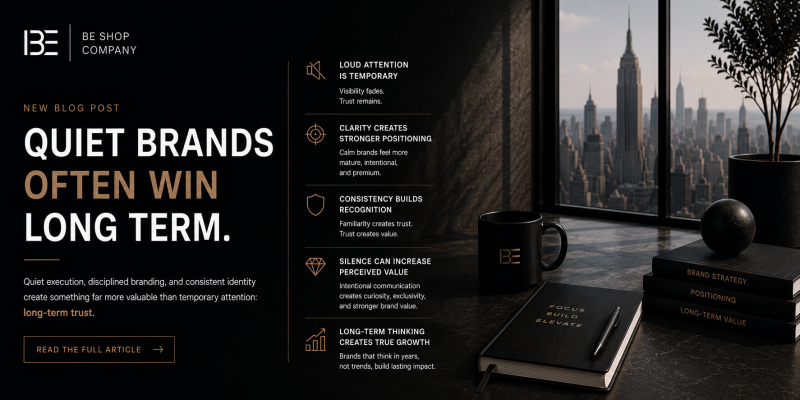
Quiet Brands Often Win Long Term
Loud attention is temporary.
Modern business culture rewards visibility.
Everyone is trying to:
- go viral,
- dominate algorithms,
- create constant engagement,
- and stay visible every day.
Because of this, many brands become extremely loud.
But loudness is not always strength.
And attention is not always trust.
Quiet brands communicate differently.
They do not constantly chase reactions.
They focus on:
- clarity,
- consistency,
- identity,
- and long-term perception.
This creates a very different type of positioning.
Calm brands often feel:
- more mature,
- more intentional,
- and more premium.
Because restraint communicates confidence.
Desperation is visible.
Customers notice when a brand is trying too hard to force attention.
Constant urgency.
Endless discounts.
Aggressive messaging.
Overposting.
Trend chasing.
All of this slowly weakens perception.
Strong brands usually feel controlled.
Not reactive.
Long-term brands protect their identity.
This is one of the biggest differences between temporary businesses and durable brands.
Weak brands adapt their identity constantly.
Strong brands evolve carefully.
They understand that recognition requires consistency.
Customers trust what feels familiar.
That familiarity becomes valuable over time.
Silence can increase perceived value.
Luxury brands have understood this for decades.
They do not communicate constantly.
They communicate intentionally.
Scarcity of communication often creates:
- curiosity,
- exclusivity,
- and stronger perceived value.
Modern internet culture often ignores this principle.
Many businesses believe more content automatically creates more authority.
But excessive communication can also reduce brand strength.
Especially when the message loses clarity.
Quiet execution creates stronger focus.
Founders who constantly react to trends often lose direction.
Their strategy changes weekly.
Their identity becomes unstable.
But focused brands operate differently.
They build slowly.
Refine carefully.
Improve consistently.
Without needing constant external validation.
Premium perception is psychological.
People associate calmness with control.
This applies to:
- leadership,
- communication,
- branding,
- and business operations.
Chaotic brands create emotional instability.
Calm brands create trust.
And trust compounds over time.
The internet rewards speed.
But brand value rewards patience.
This is important.
Many businesses optimize only for:
- short-term growth,
- quick engagement,
- and temporary visibility.
But sustainable positioning is usually built differently.
Long-term brands think in years.
Not only in trends.
Strong brands do not need to dominate every conversation.
They only need to be recognizable when they appear.
That difference matters.
A focused brand with strong identity often creates more impact than a loud brand constantly demanding attention.
Because memorability matters more than noise.
Final Thought
Quiet brands are often underestimated.
Especially in fast-moving digital culture.
But calm execution, disciplined branding, and consistent identity create something far more valuable than temporary attention:
long-term trust.
And long-term trust is one of the strongest competitive advantages a brand can build.
Conclusion
Not every brand needs to be loud to grow.
Sometimes the strongest positioning comes from restraint.
Because brands that remain clear, consistent, and intentional often outlast the brands constantly trying to stay visible.

Most Businesses Confuse Activity With Progress
Being busy does not guarantee growth.
Modern business culture celebrates movement.
More meetings.
More notifications.
More content.
More tasks.
More constant activity.
But activity and progress are not the same thing.
A business can operate all day and still move in the wrong direction.
This is one of the biggest hidden problems in entrepreneurship.
Many founders become addicted to motion.
Constant movement creates the illusion of productivity.
It feels productive to:
- answer messages constantly,
- switch between tasks,
- react to every trend,
- or stay permanently busy.
But reactive behavior often destroys strategic thinking.
Because focus disappears.
And without focus, execution becomes fragmented.
Progress usually looks repetitive.
This is why many people avoid it.
Real progress is often:
- structured,
- consistent,
- predictable,
- and sometimes even boring.
The same improvements repeated over time:
- better systems,
- clearer communication,
- stronger branding,
- cleaner operations,
- more disciplined execution.
None of these feel exciting immediately.
But they compound.
Noise creates false momentum.
The internet rewards visible activity.
This creates pressure to constantly appear active.
Many businesses start optimizing for perception instead of results.
They prioritize:
- looking busy,
- appearing successful,
- and posting constantly.
Meanwhile, the actual foundation remains weak.
Strong businesses usually operate differently.
They focus more on:
- operational clarity,
- positioning,
- customer experience,
- and long-term systems.
Focus creates leverage.
Every successful business eventually learns this.
Scattered execution weakens momentum.
Focused execution multiplies it.
When attention is divided across too many directions:
- quality decreases,
- identity weakens,
- and decision making becomes inconsistent.
Clear priorities create stronger outcomes.
Not because the business does more.
But because it removes distractions.
Strong brands are intentionally selective.
They do not chase every opportunity.
This is difficult for many founders.
Especially online, where everything feels urgent.
But constant reaction creates instability.
Strong brands protect:
- their positioning,
- their standards,
- and their long-term direction.
Because every unnecessary decision consumes energy.
Discipline creates clarity.
Disciplined businesses simplify.
They reduce:
- unnecessary meetings,
- unnecessary complexity,
- unnecessary communication,
- and unnecessary operational friction.
This creates more mental space for strategic thinking.
And strategic thinking is where real growth begins.
Most growth is invisible at first.
This is important to understand.
The strongest improvements usually happen quietly.
Better systems.
Better execution.
Better communication.
Better consistency.
These changes may not create immediate attention.
But over time, they create stronger businesses.
The appearance of progress can become dangerous.
This is where many companies lose direction.
If the business becomes too focused on looking successful, it eventually stops building real infrastructure.
The result:
- unstable growth,
- inconsistent quality,
- operational stress,
- and weak positioning.
Real progress creates durability.
Not only visibility.
Final Thought
Business growth is rarely built through constant motion alone.
It is built through focused execution repeated consistently over time.
The companies that scale successfully usually understand an important principle:
clarity creates momentum.
And momentum becomes powerful when it is directed intentionally.
Conclusion
Not all activity creates value.
Strong businesses learn to separate:
- noise from strategy,
- motion from progress,
- and visibility from real growth.
Because sustainable success is usually built through disciplined focus not constant movement.
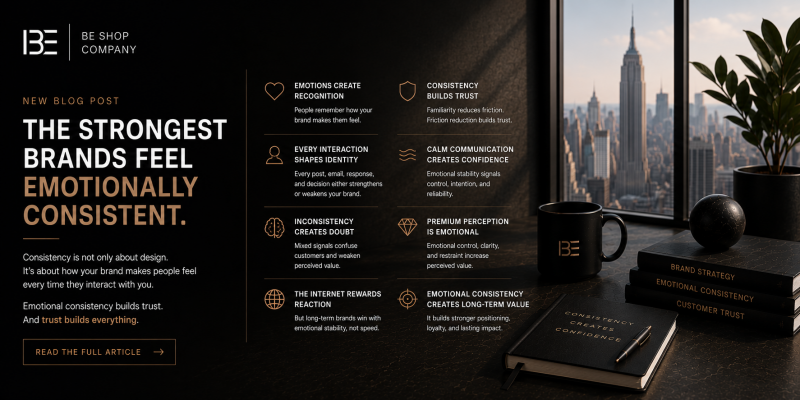
The Strongest Brands Feel Emotionally Consistent
Consistency is deeper than visuals.
Most businesses think consistency means:
- using the same colors,
- the same fonts,
- or the same logo placement.
But strong branding goes much deeper than design systems.
Real consistency is emotional.
It is about how the brand feels every time people interact with it.
Customers remember emotional patterns.
People naturally trust predictability.
When a brand consistently communicates the same emotional energy, it becomes easier to recognize and easier to trust.
This applies to:
- tone,
- customer experience,
- visual identity,
- communication style,
- and overall positioning.
Strong brands create familiarity.
And familiarity reduces psychological friction.
Emotional inconsistency weakens perception.
This happens more often than many businesses realize.
A brand may look premium visually while communicating chaotically emotionally.
For example:
- luxury visuals with desperate messaging,
- calm branding with aggressive sales tactics,
- minimal aesthetics with overloaded communication,
- or premium positioning with inconsistent customer experience.
Customers notice these contradictions immediately.
Even subconsciously.
And contradictions reduce trust.
Every interaction shapes identity.
Branding is not built only through campaigns.
It is built through repetition.
Every:
- email,
- post,
- product page,
- interaction,
- response,
- and design decision
either strengthens or weakens the emotional identity of the brand.
Strong companies understand this deeply.
They protect consistency carefully.
Calm brands create stronger trust.
Emotionally stable brands feel more controlled.
More intentional.
More reliable.
More premium.
This is psychological.
People associate emotional stability with competence.
That is why strong brands rarely feel reactive or emotionally impulsive.
They communicate with clarity.
Not emotional volatility.
Most businesses communicate from pressure.
This creates instability.
When businesses operate from:
- panic,
- urgency,
- insecurity,
- or desperation,
their communication changes constantly.
Customers feel this energy quickly.
Even if they cannot explain it directly.
Strong branding requires emotional discipline.
Premium perception is emotional.
Luxury brands rarely overreact publicly.
They do not constantly shift identity.
They do not chase every trend.
And they do not communicate from emotional pressure.
This restraint creates stronger positioning.
Because emotional control increases perceived value.
The internet amplifies inconsistency.
Modern digital culture rewards fast reactions.
But fast reactions often weaken long-term brand identity.
Businesses constantly changing:
- style,
- messaging,
- positioning,
- or communication tone
eventually become difficult to recognize.
And difficult-to-recognize brands are difficult to trust.
Strong brands feel psychologically stable.
This matters more than most founders realize.
Customers are not only evaluating:
- products,
- pricing,
- or aesthetics.
They are also evaluating emotional reliability.
Does the brand feel:
- calm,
- clear,
- structured,
- and intentional?
Or reactive, inconsistent, and unstable?
These signals influence trust constantly.
Final Thought
Strong brands do not only look consistent.
They feel emotionally consistent.
That emotional stability creates:
- familiarity,
- recognition,
- trust,
- and stronger long-term positioning.
Because customers remember how brands make them feel — not only how they look.
Conclusion
The strongest brands protect emotional consistency carefully.
Not because it looks impressive.
But because emotional clarity creates psychological trust.
And psychological trust is one of the most valuable assets a brand can build long term.
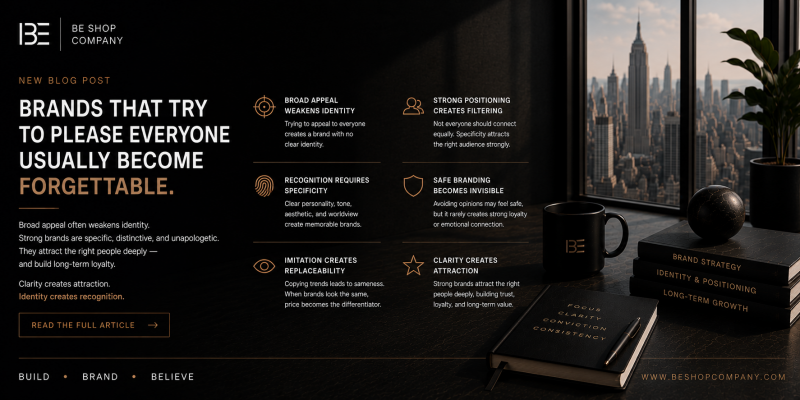
Brands That Try To Please Everyone Usually Become Forgettable
Broad appeal often weakens identity.
Many businesses believe growth comes from attracting as many people as possible.
So they try to:
- soften their positioning,
- avoid strong opinions,
- appeal to every audience,
- and communicate as broadly as possible.
At first, this feels safer.
But over time, it creates something dangerous:
a brand with no clear identity.
Recognition requires specificity.
Strong brands are recognizable because they feel distinct.
Not generic.
They communicate:
- a clear personality,
- a clear tone,
- a clear aesthetic,
- and a clear worldview.
This naturally attracts some people more strongly than others.
And that is exactly the point.
Memorable brands create emotional alignment.
People connect more deeply with brands that reflect:
- their mindset,
- their values,
- their aspirations,
- or their identity.
But emotional connection requires clarity.
If the brand becomes too neutral, too broad, or too careful, emotional impact disappears.
The result is usually:
- weak positioning,
- low memorability,
- and replaceability.
Safe branding often becomes invisible.
This is one of the biggest problems in modern marketing.
Many businesses avoid standing for anything because they fear losing potential customers.
But brands that never communicate a clear perspective rarely create strong loyalty either.
Because customers remember emotional conviction.
Not generic messaging.
Strong positioning creates natural filtering.
Great brands are intentionally selective.
They understand an important principle:
not everyone should feel equally connected to the brand.
That sounds risky.
But it actually creates stronger perception.
When positioning becomes sharper:
- recognition increases,
- memorability increases,
- emotional alignment increases,
- and loyalty becomes stronger.
Weak brands imitate trends.
This often happens when businesses lack identity.
Without a clear internal philosophy, brands begin copying:
- aesthetics,
- messaging,
- campaigns,
- and communication styles from competitors.
Over time, everything starts looking the same.
And when brands become interchangeable, price becomes the main differentiator.
That is a dangerous position.
Distinct brands protect their character.
Strong branding requires restraint and consistency.
Not constant reinvention.
Brands with strong identity usually:
- communicate intentionally,
- evolve carefully,
- and protect their positioning long term.
Because identity compounds over time.
The internet rewards imitation temporarily.
But long-term trust is built differently.
Trend chasing can create short-term visibility.
But lasting brands are usually built through:
- consistency,
- recognizable identity,
- emotional clarity,
- and strategic discipline.
Customers trust brands that feel stable and intentional.
Not brands constantly changing personalities.
Clarity creates attraction.
This is important.
Strong brands do not attract everyone equally.
They attract the right people deeply.
That emotional precision creates:
- stronger loyalty,
- stronger trust,
- stronger positioning,
- and stronger long-term value.
Final Thought
Brands become memorable when they stop trying to satisfy everyone.
Because identity requires clarity.
And clarity naturally creates differentiation.
The businesses that build the strongest long-term positioning are usually the ones willing to communicate with focus, conviction, and consistency.
Conclusion
Trying to appeal to everyone often weakens a brand.
Strong brands understand that recognition comes from distinct identity not maximum neutrality.
Because in modern business, being clearly remembered is far more valuable than being vaguely accepted.
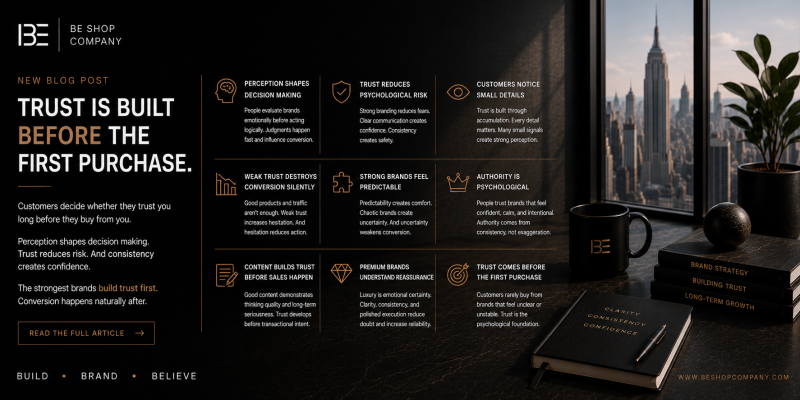
Trust Is Built Before The First Purchase
Most businesses focus too heavily on conversion.
They optimize:
- product pages,
- checkout flows,
- pricing,
- and advertising performance.
All of these matter.
But many brands ignore something more important:
customers decide whether they trust you long before they buy from you.
Perception shapes decision making.
People evaluate brands emotionally before acting logically.
Before purchasing, customers are already asking themselves:
- Does this brand feel legitimate?
- Does it feel consistent?
- Does it feel reliable?
- Does it feel intentional?
- Does it feel trustworthy?
These judgments happen quickly.
Often subconsciously.
And they heavily influence conversion.
Trust reduces psychological risk.
Every purchase contains uncertainty.
Customers wonder:
- Will the product match expectations?
- Will the experience feel professional?
- Will support exist if something goes wrong?
- Is this brand stable long term?
Strong branding reduces these fears.
Clear communication creates confidence.
Consistency creates safety.
Professional presentation creates reassurance.
Weak trust destroys conversion silently.
This is important.
Many businesses lose customers without understanding why.
The product may be good.
The pricing may be competitive.
The marketing may generate traffic.
But if trust signals are weak, hesitation increases.
And hesitation reduces action.
Customers notice small details.
Trust is built through accumulation.
Every detail matters:
- typography,
- website structure,
- response speed,
- tone of communication,
- visual consistency,
- product presentation,
- and overall clarity.
Professionalism is rarely one dramatic moment.
It is usually the result of many small signals aligned together.
Strong brands feel predictable.
Predictability creates comfort.
Customers trust brands that feel:
- emotionally stable,
- visually organized,
- operationally clear,
- and strategically consistent.
Chaotic brands create uncertainty.
And uncertainty weakens conversion.
Authority is psychological.
People naturally trust brands that appear:
- confident,
- calm,
- established,
- and intentional.
This does not require pretending to be larger than reality.
But it does require clarity and discipline.
Strong authority usually comes from consistency not exaggeration.
Content builds trust before sales happen.
This is one reason strategic content matters so much.
Good content demonstrates:
- thinking quality,
- communication quality,
- brand philosophy,
- and long-term seriousness.
Customers begin trusting brands that consistently provide value without constant pressure.
Trust often develops before transactional intent appears.
Premium brands understand reassurance.
Luxury positioning is not only about aesthetics.
It is about emotional certainty.
Strong premium brands reduce doubt through:
- controlled communication,
- consistency,
- clarity,
- restraint,
- and polished execution.
Everything feels intentional.
That intentionality increases perceived reliability.
Final Thought
The first purchase usually happens after trust already exists.
Not before.
Customers rarely buy confidently from brands that feel inconsistent, unclear, or unstable.
The strongest businesses understand that trust is not a marketing trick.
It is a psychological foundation.
Conclusion
Strong brands build trust long before conversion happens.
Through:
- clarity,
- consistency,
- emotional stability,
- and disciplined execution.
Because when customers trust the brand, buying becomes psychologically easier.
And businesses that reduce uncertainty usually build stronger long-term loyalty.
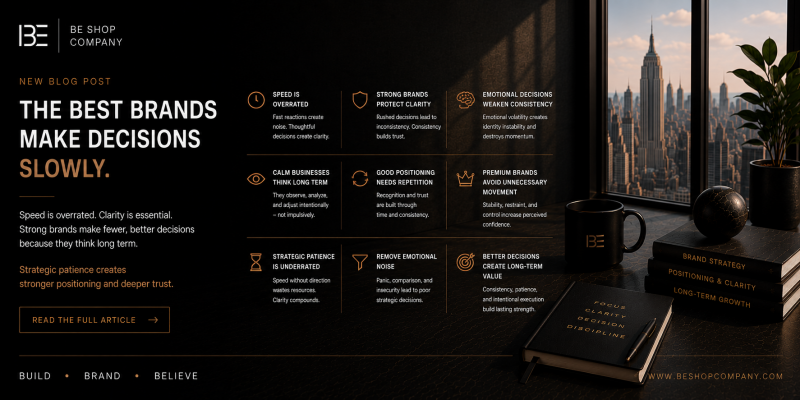
The Best Brands Make Decisions Slowly
Speed is overrated in modern business.
The internet constantly rewards fast reactions.
Fast trends.
Fast content.
Fast launches.
Fast opinions.
Fast decisions.
Because of this, many businesses begin operating impulsively.
Everything becomes reactive.
But reactive businesses often lose clarity over time.
Strong brands protect decision quality.
Not every decision should be made quickly.
Especially decisions involving:
- positioning,
- branding,
- communication,
- customer experience,
- or long-term identity.
The strongest companies understand that rushed decisions often create long-term inconsistency.
And inconsistency weakens trust.
Pressure creates bad strategy.
Many founders confuse urgency with importance.
This creates unnecessary chaos.
Businesses start changing:
- direction,
- messaging,
- aesthetics,
- pricing,
- or strategy
too frequently.
Not because the previous direction failed.
But because patience disappeared.
Strong positioning requires stability long enough to become recognizable.
Emotional decisions weaken consistency.
This happens constantly online.
One bad week.
One slow month.
One disappointing campaign.
And suddenly the business wants to reinvent everything.
But strong brands are rarely built emotionally.
They are built strategically.
Emotional volatility creates identity instability.
And unstable brands become difficult to trust.
Calm businesses think long term.
The strongest founders usually operate differently.
They:
- observe carefully,
- analyze patiently,
- and make intentional adjustments slowly.
Not because they lack ambition.
But because they understand something important:
clarity compounds faster than panic.
Good positioning needs repetition.
Customers rarely trust instantly.
Recognition takes time.
Emotional familiarity takes time.
Strong positioning becomes powerful through:
- repetition,
- consistency,
- and predictable identity.
But businesses constantly changing direction reset customer perception repeatedly.
That destroys momentum.
Premium brands avoid unnecessary movement.
Luxury positioning often feels controlled.
Minimal.
Intentional.
Stable.
Premium brands rarely communicate desperation.
And they rarely redesign themselves every few months.
This emotional restraint increases perceived confidence.
Strategic patience is underrated.
Modern business culture often glorifies speed.
But speed without clarity creates waste.
Fast execution only becomes valuable when direction is already correct.
Otherwise businesses simply scale confusion faster.
The strongest companies remove emotional noise.
This is important.
When founders operate from:
- panic,
- insecurity,
- comparison,
- or impatience,
decision quality decreases.
Strong businesses reduce emotional noise before making strategic decisions.
Because emotional clarity improves strategic clarity.
Final Thought
Not every opportunity deserves immediate action.
Not every trend deserves attention.
And not every problem requires dramatic change.
The strongest brands often grow slower externally because they move more carefully internally.
But over time, intentional decisions create stronger positioning, stronger trust, and stronger long-term stability.
Conclusion
Strong businesses are not built only through speed.
They are built through disciplined decision making.
Because long-term brand value usually comes from:
- consistency,
- strategic patience,
- emotional control,
- and intentional execution.
And those qualities are difficult to build in reactive environments.